
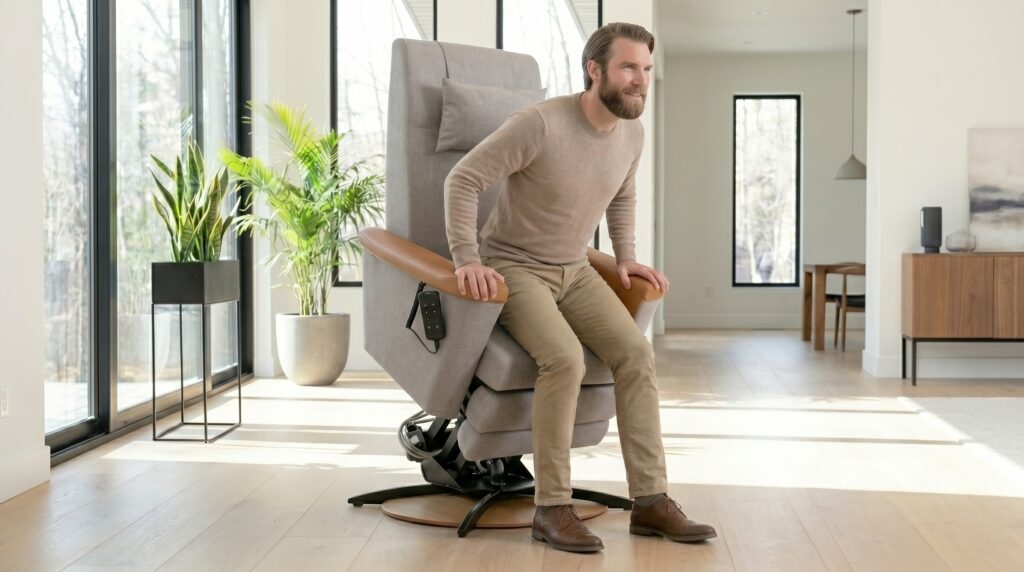

For many people, aging in place doesn’t mean redesigning their entire life.
It means continuing to wake up in the same bedroom.
Making coffee in the same kitchen.
Reading beside the same window.
Watching television from a favorite corner of the living room.
And staying connected to the home they’ve built over many years.
Sometimes, however, very ordinary movements begin to require more effort.
One of them is something most of us rarely think about:
Getting out of a chair.
A deep sofa or low recliner may still be wonderfully comfortable, but transitioning from sitting to standing can become more demanding over time.
That’s where a lift chair for independent living can become useful.
Rather than turning the home into a clinical environment, thoughtfully designed powered seating can integrate supportive functionality into an ordinary piece of living-room furniture.
Here’s how lift chairs can fit into a broader aging-in-place strategy—and what they can and cannot do.
What Does Independent Living Really Mean?
Independence doesn’t necessarily mean doing absolutely everything without assistance.
It means having an environment that allows you to participate in everyday life as comfortably and confidently as possible.
That environment may include thoughtful changes such as:
- Better lighting
- Clearer walking paths
- Appropriate furniture height
- Accessible storage
- Easy-to-use controls
- Supportive seating
- Thoughtful bathroom design
- Reduced unnecessary obstacles
A lift chair can be one part of that environment.
It doesn’t replace the home.
It adapts one of the places where people spend a significant amount of time.
Why Ordinary Chairs Can Become More Difficult Over Time
Standing from a chair involves more than simply moving upward.
The body shifts forward.
The feet establish a stable position.
The torso moves over the base of support.
The legs participate in bringing the body toward standing.
Furniture influences that movement.
A very low, soft, or deep chair may require a different transition than a firmer seat positioned at a more suitable height.
That’s why choosing supportive seating isn’t simply about finding the softest chair.
Chair geometry matters.
How Does a Lift Chair Assist With Standing?
A power lift chair uses an electrically powered mechanism to raise and tilt the seating surface forward.
This changes the user’s starting position for standing.
Instead of beginning from a deep seated position, the user is gradually brought toward a higher and more forward position.
Importantly, a lift chair shouldn’t be described as automatically standing someone up.
The person still participates in the transition.
Think of it as powered assistance toward standing, rather than a machine that replaces the user’s movement.
The PHLEXI Chair – Yushan Award combines this powered stand-up assistance with adjustable seat height, independent backrest and footrest positioning, and Zero Gravity functionality.
That allows the chair to serve both everyday relaxation and supportive positioning.
Why Adjustable Seat Height Matters
Seat height is one of the most important—and frequently overlooked—parts of chair fit.
A seat that is too low may make the transition toward standing more demanding.
A seat that is too high may make comfortable foot placement more difficult.
People also have different body proportions.
A fixed seat height that works beautifully for one family member may not feel right for another.
The PHLEXI Chair 4A offers adjustable seat height from approximately 42–60 cm.
That additional flexibility allows the seating position to be adapted more closely to the user instead of expecting every person to fit one predetermined chair height.
Independence Isn’t Only About Standing
If a chair is used several hours every day, standing assistance is only one part of the experience.
Think about everything someone might do while sitting:
- Read
- Watch television
- Talk with family
- Use a tablet
- Drink coffee
- Rest
- Listen to music
- Look out the window
A chair that supports independent living should also be comfortable during those ordinary moments.
That’s why adjustable backrest, footrest, seat positioning, and reclining functions matter.
The chair shouldn’t only help someone leave it.
It should be a place they genuinely enjoy sitting in.
Independent Backrest and Footrest Adjustment Adds Flexibility
A basic recliner may move the backrest and footrest together.
That can be perfectly adequate for simple relaxation.
But independent adjustment gives the user more control.
For example, someone may want to:
Elevate the feet while reading relatively upright.
Later they may:
Recline more deeply while watching television.
And later still:
Move into a Zero Gravity-style position for relaxation.
This flexibility can make one chair useful across different parts of the day.
Instead of changing furniture, the furniture changes with the user.
What Role Does Zero Gravity Play?
Zero Gravity is a positioning feature available on some advanced power lift chairs.
In furniture, it generally describes a supported reclined position in which the legs are elevated relative to ordinary upright sitting while the backrest reclines.
It should be understood as a comfort and positioning option, not a medical treatment.
For someone planning a chair for long-term everyday use, the value is flexibility.
Upright when desired.
Feet elevated when desired.
More deeply reclined when desired.
And powered assistance toward standing when it’s time to move again.
A Lift Chair Can Reduce Dependence on Furniture Around You
Watch how someone gets out of a difficult chair.
They may:
Push heavily on the armrests.
Grab a nearby table.
Pull on furniture.
Rock several times.
Ask another person for a hand.
Some of these strategies may create their own problems.
A properly fitted lift chair can provide a more intentional powered transition.
But chair selection matters.
The goal isn’t simply to purchase something labeled “lift chair.”
It is to choose a chair appropriate for the person using it.
A Lift Chair Isn’t a Replacement for All Mobility Assistance
This distinction is important.
A lift chair may assist an appropriate user with the sit-to-stand transition.
It doesn’t replace:
- A walking aid when one is needed
- Transfer equipment
- Individual rehabilitation
- Professional assessment
- Human assistance when substantial assistance is required
Someone who cannot safely bear weight, has significant balance difficulty, or requires substantial transfer assistance may need a broader solution.
A lift chair is one tool within the home—not a universal answer to every mobility challenge.
Independence Starts With the Space Around the Chair
Even the most advanced lift chair won’t create an accessible environment if the surrounding room is difficult to navigate.
Look at the area in front of the chair.
Is it clear?
Check the walking route toward:
- Bathroom
- Kitchen
- Bedroom
- Front door
Remove unnecessary obstacles such as:
- Loose cables
- Shoes
- Bags
- Small tables
- Unstable rugs
- Pet toys
Also consider lighting.
Someone transitioning from sitting to standing should be able to see the floor and walking path clearly.
For more ideas about creating a comfortable home environment, explore THE LIVE YOUNG’s Home Care Resource Center.
Don’t Forget the Controller
Independence also depends on usability.
A chair may have excellent engineering, but if the person can’t understand its controller, they may still need someone else’s help every time they want to change position.
Ask:
- Are the buttons understandable?
- Can the user see them?
- Can they comfortably press them?
- Can they hold the controller?
- Can they stop at intermediate positions?
- Can they find the controller easily?
Keep it in a consistent, accessible location.
Technology should reduce unnecessary dependence—not introduce a new reason to ask for help.
Think About Power Outages Before They Happen
Powered independence depends on electricity.
If someone relies heavily on a lift chair’s standing-assistance function, understand what happens during a power interruption.
Backup capability varies by product.
Check:
- Whether backup power is available
- Which functions it supports
- How the backup system is maintained
- What the user should do during an outage
This becomes particularly important for someone living alone.
Aging-in-place planning should consider occasional disruptions, not only normal days.
Can a Lift Chair Help Caregivers Too?
A thoughtfully selected chair may also change the interaction between the user and family members.
Imagine a parent who frequently asks:
“Can you pull me up?”
A powered lift mechanism may allow an appropriate user to manage more of the transition themselves.
That doesn’t eliminate the role of family or caregivers.
Instead, supportive furniture can sometimes allow assistance to be focused where it’s genuinely needed.
The goal isn’t to replace human connection with technology.
It’s to use technology intelligently.
The Best Aging-in-Place Furniture Doesn’t Look Like Equipment
One reason people resist supportive furniture is psychological.
They may associate it with:
Hospitals.
Care facilities.
Illness.
Loss of independence.
But supportive design doesn’t have to look clinical.
A lift chair can sit beside:
- A beautiful rug
- Oak side table
- Contemporary sofa
- Books
- Artwork
- Plants
- Family photographs
It can simply look like someone’s favorite chair.
That’s an important design principle for THE LIVE YOUNG.
Accessibility should become part of the home—not take over the home.
Don’t Wait Until Furniture Becomes a Problem
Many people only think about supportive furniture after standing has already become difficult.
But aging-in-place planning can begin earlier.
Someone may currently have no difficulty standing but already be shopping for a premium recliner.
In that situation, it can be reasonable to consider whether the same chair could offer functionality that may become useful later.
That doesn’t mean buying medical-looking equipment “just in case.”
It means choosing adaptable furniture.
A chair can be purchased because it’s comfortable today while still being useful if needs change tomorrow.
What About Staying Active While Sitting?
Independent living isn’t only about making standing easier.
Long periods of sitting are also part of many people’s daily routines.
Powered seating can approach this in different ways.
The MOTiVO Passive Exercise Recliner integrates passive movement technology into residential seating with multiple speeds, positions, and programs.
This represents a different philosophy of supportive seating:
Not simply asking how furniture helps someone leave the chair, but also what can happen during the hours they spend in the chair.
Explore THE LIVE YOUNG Seating Solutions
PHLEXI Chair – Yushan Award
The PHLEXI Chair – Yushan Award combines powered stand-up assistance with:
- Adjustable seat height
- Independent backrest positioning
- Independent footrest positioning
- Zero Gravity functionality
- Premium residential design
It is designed around the idea that supportive functionality and beautiful home furniture can exist together.
PHLEXI Chair 4A
The PHLEXI Chair 4A provides:
- Adjustable seat height: approximately 42–60 cm
- Backrest adjustment
- Footrest adjustment
- Seat tilt adjustment
- Zero Gravity positioning
- Powered stand-up assistance
- Maximum reclining angle: approximately 150°
- Maximum load: approximately 120 kg
Its standing-assistance movement can be stopped before maximum extension, allowing the user to choose an appropriate transition position.
MOTiVO Passive Exercise Recliner
The MOTiVO Passive Exercise Recliner combines comfortable residential seating with passive movement technology, multiple speeds, positions, and programs.
Explore More Home Care Resources
Visit THE LIVE YOUNG’s Home Care Resource Center for more guidance about lift chairs, supportive furniture, home care, and designing environments for long-term independent living.
Aging-in-Place Lift Chair Checklist
When choosing a lift chair for independent living, ask:
- Does the chair fit the user’s height?
- Is the seat depth appropriate?
- Is the seat width comfortable?
- Is seat height appropriate or adjustable?
- Is the user within the weight capacity?
- Can the user operate the controller independently?
- Does the chair offer controllable standing assistance?
- Can the lift movement stop at useful intermediate positions?
- Can the backrest and footrest be adjusted independently?
- Is Zero Gravity useful to the user?
- Is there enough space for full reclining?
- Is the standing area in front clear?
- Is the walking route from the chair unobstructed?
- Is the power connection safely positioned?
- Is power-outage planning appropriate?
- Does the chair look and feel like something the user actually wants in their home?
The last question matters.
People are much more likely to use supportive furniture when they actually enjoy living with it.
Frequently Asked Questions
Can a lift chair help an older adult live independently?
A lift chair can provide powered positioning and assistance toward standing for an appropriate user. Independent living, however, depends on the person’s broader abilities and home environment, so a lift chair should be viewed as one part of an aging-in-place strategy.
Are lift chairs only for people who already have mobility problems?
No. Some people choose lift chairs because they want premium powered reclining today while also planning for functionality that may become useful later.
Does a lift chair completely stand you up?
A lift chair raises and tilts the seat to assist the transition toward standing. The user still participates in the movement.
What is the most important lift-chair feature for aging in place?
There isn’t one feature that suits everyone. Proper user fit, appropriate seat height, easy controls, standing assistance, positioning flexibility, and room setup should all be considered together.
Can couples share one lift chair?
They can, provided the chair appropriately fits both users. Significant differences in height or body proportions may make an adjustable chair more useful, but each person’s comfort should be evaluated.
Is a lift chair better than asking a caregiver for help?
That depends on the individual. A lift chair may allow an appropriate user to manage more of their sit-to-stand transition independently, but it doesn’t replace necessary caregiver assistance or specialized transfer support.
Final Thoughts: Independence Can Start With Something as Simple as a Chair
A lift chair for independent living isn’t about making someone feel older.
It’s about asking a better question:
How can the home continue working for the person who lives there?
Sometimes the answer is better lighting.
Sometimes it’s removing a loose rug.
Sometimes it’s reorganizing a kitchen.
And sometimes it’s replacing a low, difficult chair with furniture that can adjust, recline, elevate, and assist when it’s time to stand.
At THE LIVE YOUNG, we believe aging in place should not mean turning a beloved home into a care facility.
Good design can support changing needs while preserving the things that make a home feel personal.
Comfort.
Beauty.
Routine.
Choice.
And independence.
Because living young isn’t about pretending that our needs never change.
It’s about creating a life—and a home—that can change with us.
For many people, aging in place doesn’t mean redesigning their entire life.
It means continuing to wake up in the same bedroom.
Making coffee in the same kitchen.
Reading beside the same window.
Watching television from a favorite corner of the living room.
And staying connected to the home they’ve built over many years.
Sometimes, however, very ordinary movements begin to require more effort.
One of them is something most of us rarely think about:
Getting out of a chair.
A deep sofa or low recliner may still be wonderfully comfortable, but transitioning from sitting to standing can become more demanding over time.
That’s where a lift chair for independent living can become useful.
Rather than turning the home into a clinical environment, thoughtfully designed powered seating can integrate supportive functionality into an ordinary piece of living-room furniture.
Here’s how lift chairs can fit into a broader aging-in-place strategy—and what they can and cannot do.
What Does Independent Living Really Mean?
Independence doesn’t necessarily mean doing absolutely everything without assistance.
It means having an environment that allows you to participate in everyday life as comfortably and confidently as possible.
That environment may include thoughtful changes such as:
- Better lighting
- Clearer walking paths
- Appropriate furniture height
- Accessible storage
- Easy-to-use controls
- Supportive seating
- Thoughtful bathroom design
- Reduced unnecessary obstacles
A lift chair can be one part of that environment.
It doesn’t replace the home.
It adapts one of the places where people spend a significant amount of time.
Why Ordinary Chairs Can Become More Difficult Over Time
Standing from a chair involves more than simply moving upward.
The body shifts forward.
The feet establish a stable position.
The torso moves over the base of support.
The legs participate in bringing the body toward standing.
Furniture influences that movement.
A very low, soft, or deep chair may require a different transition than a firmer seat positioned at a more suitable height.
That’s why choosing supportive seating isn’t simply about finding the softest chair.
Chair geometry matters.
How Does a Lift Chair Assist With Standing?
A power lift chair uses an electrically powered mechanism to raise and tilt the seating surface forward.
This changes the user’s starting position for standing.
Instead of beginning from a deep seated position, the user is gradually brought toward a higher and more forward position.
Importantly, a lift chair shouldn’t be described as automatically standing someone up.
The person still participates in the transition.
Think of it as powered assistance toward standing, rather than a machine that replaces the user’s movement.
The PHLEXI Chair – Yushan Award combines this powered stand-up assistance with adjustable seat height, independent backrest and footrest positioning, and Zero Gravity functionality.
That allows the chair to serve both everyday relaxation and supportive positioning.
Why Adjustable Seat Height Matters
Seat height is one of the most important—and frequently overlooked—parts of chair fit.
A seat that is too low may make the transition toward standing more demanding.
A seat that is too high may make comfortable foot placement more difficult.
People also have different body proportions.
A fixed seat height that works beautifully for one family member may not feel right for another.
The PHLEXI Chair 4A offers adjustable seat height from approximately 42–60 cm.
That additional flexibility allows the seating position to be adapted more closely to the user instead of expecting every person to fit one predetermined chair height.
Independence Isn’t Only About Standing
If a chair is used several hours every day, standing assistance is only one part of the experience.
Think about everything someone might do while sitting:
- Read
- Watch television
- Talk with family
- Use a tablet
- Drink coffee
- Rest
- Listen to music
- Look out the window
A chair that supports independent living should also be comfortable during those ordinary moments.
That’s why adjustable backrest, footrest, seat positioning, and reclining functions matter.
The chair shouldn’t only help someone leave it.
It should be a place they genuinely enjoy sitting in.
Independent Backrest and Footrest Adjustment Adds Flexibility
A basic recliner may move the backrest and footrest together.
That can be perfectly adequate for simple relaxation.
But independent adjustment gives the user more control.
For example, someone may want to:
Elevate the feet while reading relatively upright.
Later they may:
Recline more deeply while watching television.
And later still:
Move into a Zero Gravity-style position for relaxation.
This flexibility can make one chair useful across different parts of the day.
Instead of changing furniture, the furniture changes with the user.
What Role Does Zero Gravity Play?
Zero Gravity is a positioning feature available on some advanced power lift chairs.
In furniture, it generally describes a supported reclined position in which the legs are elevated relative to ordinary upright sitting while the backrest reclines.
It should be understood as a comfort and positioning option, not a medical treatment.
For someone planning a chair for long-term everyday use, the value is flexibility.
Upright when desired.
Feet elevated when desired.
More deeply reclined when desired.
And powered assistance toward standing when it’s time to move again.
A Lift Chair Can Reduce Dependence on Furniture Around You
Watch how someone gets out of a difficult chair.
They may:
Push heavily on the armrests.
Grab a nearby table.
Pull on furniture.
Rock several times.
Ask another person for a hand.
Some of these strategies may create their own problems.
A properly fitted lift chair can provide a more intentional powered transition.
But chair selection matters.
The goal isn’t simply to purchase something labeled “lift chair.”
It is to choose a chair appropriate for the person using it.
A Lift Chair Isn’t a Replacement for All Mobility Assistance
This distinction is important.
A lift chair may assist an appropriate user with the sit-to-stand transition.
It doesn’t replace:
- A walking aid when one is needed
- Transfer equipment
- Individual rehabilitation
- Professional assessment
- Human assistance when substantial assistance is required
Someone who cannot safely bear weight, has significant balance difficulty, or requires substantial transfer assistance may need a broader solution.
A lift chair is one tool within the home—not a universal answer to every mobility challenge.
Independence Starts With the Space Around the Chair
Even the most advanced lift chair won’t create an accessible environment if the surrounding room is difficult to navigate.
Look at the area in front of the chair.
Is it clear?
Check the walking route toward:
- Bathroom
- Kitchen
- Bedroom
- Front door
Remove unnecessary obstacles such as:
- Loose cables
- Shoes
- Bags
- Small tables
- Unstable rugs
- Pet toys
Also consider lighting.
Someone transitioning from sitting to standing should be able to see the floor and walking path clearly.
For more ideas about creating a comfortable home environment, explore THE LIVE YOUNG’s Home Care Resource Center.
Don’t Forget the Controller
Independence also depends on usability.
A chair may have excellent engineering, but if the person can’t understand its controller, they may still need someone else’s help every time they want to change position.
Ask:
- Are the buttons understandable?
- Can the user see them?
- Can they comfortably press them?
- Can they hold the controller?
- Can they stop at intermediate positions?
- Can they find the controller easily?
Keep it in a consistent, accessible location.
Technology should reduce unnecessary dependence—not introduce a new reason to ask for help.
Think About Power Outages Before They Happen
Powered independence depends on electricity.
If someone relies heavily on a lift chair’s standing-assistance function, understand what happens during a power interruption.
Backup capability varies by product.
Check:
- Whether backup power is available
- Which functions it supports
- How the backup system is maintained
- What the user should do during an outage
This becomes particularly important for someone living alone.
Aging-in-place planning should consider occasional disruptions, not only normal days.
Can a Lift Chair Help Caregivers Too?
A thoughtfully selected chair may also change the interaction between the user and family members.
Imagine a parent who frequently asks:
“Can you pull me up?”
A powered lift mechanism may allow an appropriate user to manage more of the transition themselves.
That doesn’t eliminate the role of family or caregivers.
Instead, supportive furniture can sometimes allow assistance to be focused where it’s genuinely needed.
The goal isn’t to replace human connection with technology.
It’s to use technology intelligently.
The Best Aging-in-Place Furniture Doesn’t Look Like Equipment
One reason people resist supportive furniture is psychological.
They may associate it with:
Hospitals.
Care facilities.
Illness.
Loss of independence.
But supportive design doesn’t have to look clinical.
A lift chair can sit beside:
- A beautiful rug
- Oak side table
- Contemporary sofa
- Books
- Artwork
- Plants
- Family photographs
It can simply look like someone’s favorite chair.
That’s an important design principle for THE LIVE YOUNG.
Accessibility should become part of the home—not take over the home.
Don’t Wait Until Furniture Becomes a Problem
Many people only think about supportive furniture after standing has already become difficult.
But aging-in-place planning can begin earlier.
Someone may currently have no difficulty standing but already be shopping for a premium recliner.
In that situation, it can be reasonable to consider whether the same chair could offer functionality that may become useful later.
That doesn’t mean buying medical-looking equipment “just in case.”
It means choosing adaptable furniture.
A chair can be purchased because it’s comfortable today while still being useful if needs change tomorrow.
What About Staying Active While Sitting?
Independent living isn’t only about making standing easier.
Long periods of sitting are also part of many people’s daily routines.
Powered seating can approach this in different ways.
The MOTiVO Passive Exercise Recliner integrates passive movement technology into residential seating with multiple speeds, positions, and programs.
This represents a different philosophy of supportive seating:
Not simply asking how furniture helps someone leave the chair, but also what can happen during the hours they spend in the chair.
Explore THE LIVE YOUNG Seating Solutions
PHLEXI Chair – Yushan Award
The PHLEXI Chair – Yushan Award combines powered stand-up assistance with:
- Adjustable seat height
- Independent backrest positioning
- Independent footrest positioning
- Zero Gravity functionality
- Premium residential design
It is designed around the idea that supportive functionality and beautiful home furniture can exist together.
PHLEXI Chair 4A
The PHLEXI Chair 4A provides:
- Adjustable seat height: approximately 42–60 cm
- Backrest adjustment
- Footrest adjustment
- Seat tilt adjustment
- Zero Gravity positioning
- Powered stand-up assistance
- Maximum reclining angle: approximately 150°
- Maximum load: approximately 120 kg
Its standing-assistance movement can be stopped before maximum extension, allowing the user to choose an appropriate transition position.
MOTiVO Passive Exercise Recliner
The MOTiVO Passive Exercise Recliner combines comfortable residential seating with passive movement technology, multiple speeds, positions, and programs.
Explore More Home Care Resources
Visit THE LIVE YOUNG’s Home Care Resource Center for more guidance about lift chairs, supportive furniture, home care, and designing environments for long-term independent living.
Aging-in-Place Lift Chair Checklist
When choosing a lift chair for independent living, ask:
- Does the chair fit the user’s height?
- Is the seat depth appropriate?
- Is the seat width comfortable?
- Is seat height appropriate or adjustable?
- Is the user within the weight capacity?
- Can the user operate the controller independently?
- Does the chair offer controllable standing assistance?
- Can the lift movement stop at useful intermediate positions?
- Can the backrest and footrest be adjusted independently?
- Is Zero Gravity useful to the user?
- Is there enough space for full reclining?
- Is the standing area in front clear?
- Is the walking route from the chair unobstructed?
- Is the power connection safely positioned?
- Is power-outage planning appropriate?
- Does the chair look and feel like something the user actually wants in their home?
The last question matters.
People are much more likely to use supportive furniture when they actually enjoy living with it.
Frequently Asked Questions
Can a lift chair help an older adult live independently?
A lift chair can provide powered positioning and assistance toward standing for an appropriate user. Independent living, however, depends on the person’s broader abilities and home environment, so a lift chair should be viewed as one part of an aging-in-place strategy.
Are lift chairs only for people who already have mobility problems?
No. Some people choose lift chairs because they want premium powered reclining today while also planning for functionality that may become useful later.
Does a lift chair completely stand you up?
A lift chair raises and tilts the seat to assist the transition toward standing. The user still participates in the movement.
What is the most important lift-chair feature for aging in place?
There isn’t one feature that suits everyone. Proper user fit, appropriate seat height, easy controls, standing assistance, positioning flexibility, and room setup should all be considered together.
Can couples share one lift chair?
They can, provided the chair appropriately fits both users. Significant differences in height or body proportions may make an adjustable chair more useful, but each person’s comfort should be evaluated.
Is a lift chair better than asking a caregiver for help?
That depends on the individual. A lift chair may allow an appropriate user to manage more of their sit-to-stand transition independently, but it doesn’t replace necessary caregiver assistance or specialized transfer support.
Final Thoughts: Independence Can Start With Something as Simple as a Chair
A lift chair for independent living isn’t about making someone feel older.
It’s about asking a better question:
How can the home continue working for the person who lives there?
Sometimes the answer is better lighting.
Sometimes it’s removing a loose rug.
Sometimes it’s reorganizing a kitchen.
And sometimes it’s replacing a low, difficult chair with furniture that can adjust, recline, elevate, and assist when it’s time to stand.
At THE LIVE YOUNG, we believe aging in place should not mean turning a beloved home into a care facility.
Good design can support changing needs while preserving the things that make a home feel personal.
Comfort.
Beauty.
Routine.
Choice.
And independence.
Because living young isn’t about pretending that our needs never change.
It’s about creating a life—and a home—that can change with us.
For many people, aging in place doesn’t mean redesigning their entire life.
It means continuing to wake up in the same bedroom.
Making coffee in the same kitchen.
Reading beside the same window.
Watching television from a favorite corner of the living room.
And staying connected to the home they’ve built over many years.
Sometimes, however, very ordinary movements begin to require more effort.
One of them is something most of us rarely think about:
Getting out of a chair.
A deep sofa or low recliner may still be wonderfully comfortable, but transitioning from sitting to standing can become more demanding over time.
That’s where a lift chair for independent living can become useful.
Rather than turning the home into a clinical environment, thoughtfully designed powered seating can integrate supportive functionality into an ordinary piece of living-room furniture.
Here’s how lift chairs can fit into a broader aging-in-place strategy—and what they can and cannot do.
What Does Independent Living Really Mean?
Independence doesn’t necessarily mean doing absolutely everything without assistance.
It means having an environment that allows you to participate in everyday life as comfortably and confidently as possible.
That environment may include thoughtful changes such as:
- Better lighting
- Clearer walking paths
- Appropriate furniture height
- Accessible storage
- Easy-to-use controls
- Supportive seating
- Thoughtful bathroom design
- Reduced unnecessary obstacles
A lift chair can be one part of that environment.
It doesn’t replace the home.
It adapts one of the places where people spend a significant amount of time.
Why Ordinary Chairs Can Become More Difficult Over Time
Standing from a chair involves more than simply moving upward.
The body shifts forward.
The feet establish a stable position.
The torso moves over the base of support.
The legs participate in bringing the body toward standing.
Furniture influences that movement.
A very low, soft, or deep chair may require a different transition than a firmer seat positioned at a more suitable height.
That’s why choosing supportive seating isn’t simply about finding the softest chair.
Chair geometry matters.
How Does a Lift Chair Assist With Standing?
A power lift chair uses an electrically powered mechanism to raise and tilt the seating surface forward.
This changes the user’s starting position for standing.
Instead of beginning from a deep seated position, the user is gradually brought toward a higher and more forward position.
Importantly, a lift chair shouldn’t be described as automatically standing someone up.
The person still participates in the transition.
Think of it as powered assistance toward standing, rather than a machine that replaces the user’s movement.
The PHLEXI Chair – Yushan Award combines this powered stand-up assistance with adjustable seat height, independent backrest and footrest positioning, and Zero Gravity functionality.
That allows the chair to serve both everyday relaxation and supportive positioning.
Why Adjustable Seat Height Matters
Seat height is one of the most important—and frequently overlooked—parts of chair fit.
A seat that is too low may make the transition toward standing more demanding.
A seat that is too high may make comfortable foot placement more difficult.
People also have different body proportions.
A fixed seat height that works beautifully for one family member may not feel right for another.
The PHLEXI Chair 4A offers adjustable seat height from approximately 42–60 cm.
That additional flexibility allows the seating position to be adapted more closely to the user instead of expecting every person to fit one predetermined chair height.
Independence Isn’t Only About Standing
If a chair is used several hours every day, standing assistance is only one part of the experience.
Think about everything someone might do while sitting:
- Read
- Watch television
- Talk with family
- Use a tablet
- Drink coffee
- Rest
- Listen to music
- Look out the window
A chair that supports independent living should also be comfortable during those ordinary moments.
That’s why adjustable backrest, footrest, seat positioning, and reclining functions matter.
The chair shouldn’t only help someone leave it.
It should be a place they genuinely enjoy sitting in.
Independent Backrest and Footrest Adjustment Adds Flexibility
A basic recliner may move the backrest and footrest together.
That can be perfectly adequate for simple relaxation.
But independent adjustment gives the user more control.
For example, someone may want to:
Elevate the feet while reading relatively upright.
Later they may:
Recline more deeply while watching television.
And later still:
Move into a Zero Gravity-style position for relaxation.
This flexibility can make one chair useful across different parts of the day.
Instead of changing furniture, the furniture changes with the user.
What Role Does Zero Gravity Play?
Zero Gravity is a positioning feature available on some advanced power lift chairs.
In furniture, it generally describes a supported reclined position in which the legs are elevated relative to ordinary upright sitting while the backrest reclines.
It should be understood as a comfort and positioning option, not a medical treatment.
For someone planning a chair for long-term everyday use, the value is flexibility.
Upright when desired.
Feet elevated when desired.
More deeply reclined when desired.
And powered assistance toward standing when it’s time to move again.
A Lift Chair Can Reduce Dependence on Furniture Around You
Watch how someone gets out of a difficult chair.
They may:
Push heavily on the armrests.
Grab a nearby table.
Pull on furniture.
Rock several times.
Ask another person for a hand.
Some of these strategies may create their own problems.
A properly fitted lift chair can provide a more intentional powered transition.
But chair selection matters.
The goal isn’t simply to purchase something labeled “lift chair.”
It is to choose a chair appropriate for the person using it.
A Lift Chair Isn’t a Replacement for All Mobility Assistance
This distinction is important.
A lift chair may assist an appropriate user with the sit-to-stand transition.
It doesn’t replace:
- A walking aid when one is needed
- Transfer equipment
- Individual rehabilitation
- Professional assessment
- Human assistance when substantial assistance is required
Someone who cannot safely bear weight, has significant balance difficulty, or requires substantial transfer assistance may need a broader solution.
A lift chair is one tool within the home—not a universal answer to every mobility challenge.
Independence Starts With the Space Around the Chair
Even the most advanced lift chair won’t create an accessible environment if the surrounding room is difficult to navigate.
Look at the area in front of the chair.
Is it clear?
Check the walking route toward:
- Bathroom
- Kitchen
- Bedroom
- Front door
Remove unnecessary obstacles such as:
- Loose cables
- Shoes
- Bags
- Small tables
- Unstable rugs
- Pet toys
Also consider lighting.
Someone transitioning from sitting to standing should be able to see the floor and walking path clearly.
For more ideas about creating a comfortable home environment, explore THE LIVE YOUNG’s Home Care Resource Center.
Don’t Forget the Controller
Independence also depends on usability.
A chair may have excellent engineering, but if the person can’t understand its controller, they may still need someone else’s help every time they want to change position.
Ask:
- Are the buttons understandable?
- Can the user see them?
- Can they comfortably press them?
- Can they hold the controller?
- Can they stop at intermediate positions?
- Can they find the controller easily?
Keep it in a consistent, accessible location.
Technology should reduce unnecessary dependence—not introduce a new reason to ask for help.
Think About Power Outages Before They Happen
Powered independence depends on electricity.
If someone relies heavily on a lift chair’s standing-assistance function, understand what happens during a power interruption.
Backup capability varies by product.
Check:
- Whether backup power is available
- Which functions it supports
- How the backup system is maintained
- What the user should do during an outage
This becomes particularly important for someone living alone.
Aging-in-place planning should consider occasional disruptions, not only normal days.
Can a Lift Chair Help Caregivers Too?
A thoughtfully selected chair may also change the interaction between the user and family members.
Imagine a parent who frequently asks:
“Can you pull me up?”
A powered lift mechanism may allow an appropriate user to manage more of the transition themselves.
That doesn’t eliminate the role of family or caregivers.
Instead, supportive furniture can sometimes allow assistance to be focused where it’s genuinely needed.
The goal isn’t to replace human connection with technology.
It’s to use technology intelligently.
The Best Aging-in-Place Furniture Doesn’t Look Like Equipment
One reason people resist supportive furniture is psychological.
They may associate it with:
Hospitals.
Care facilities.
Illness.
Loss of independence.
But supportive design doesn’t have to look clinical.
A lift chair can sit beside:
- A beautiful rug
- Oak side table
- Contemporary sofa
- Books
- Artwork
- Plants
- Family photographs
It can simply look like someone’s favorite chair.
That’s an important design principle for THE LIVE YOUNG.
Accessibility should become part of the home—not take over the home.
Don’t Wait Until Furniture Becomes a Problem
Many people only think about supportive furniture after standing has already become difficult.
But aging-in-place planning can begin earlier.
Someone may currently have no difficulty standing but already be shopping for a premium recliner.
In that situation, it can be reasonable to consider whether the same chair could offer functionality that may become useful later.
That doesn’t mean buying medical-looking equipment “just in case.”
It means choosing adaptable furniture.
A chair can be purchased because it’s comfortable today while still being useful if needs change tomorrow.
What About Staying Active While Sitting?
Independent living isn’t only about making standing easier.
Long periods of sitting are also part of many people’s daily routines.
Powered seating can approach this in different ways.
The MOTiVO Passive Exercise Recliner integrates passive movement technology into residential seating with multiple speeds, positions, and programs.
This represents a different philosophy of supportive seating:
Not simply asking how furniture helps someone leave the chair, but also what can happen during the hours they spend in the chair.
Explore THE LIVE YOUNG Seating Solutions
PHLEXI Chair – Yushan Award
The PHLEXI Chair – Yushan Award combines powered stand-up assistance with:
- Adjustable seat height
- Independent backrest positioning
- Independent footrest positioning
- Zero Gravity functionality
- Premium residential design
It is designed around the idea that supportive functionality and beautiful home furniture can exist together.
PHLEXI Chair 4A
The PHLEXI Chair 4A provides:
- Adjustable seat height: approximately 42–60 cm
- Backrest adjustment
- Footrest adjustment
- Seat tilt adjustment
- Zero Gravity positioning
- Powered stand-up assistance
- Maximum reclining angle: approximately 150°
- Maximum load: approximately 120 kg
Its standing-assistance movement can be stopped before maximum extension, allowing the user to choose an appropriate transition position.
MOTiVO Passive Exercise Recliner
The MOTiVO Passive Exercise Recliner combines comfortable residential seating with passive movement technology, multiple speeds, positions, and programs.
Explore More Home Care Resources
Visit THE LIVE YOUNG’s Home Care Resource Center for more guidance about lift chairs, supportive furniture, home care, and designing environments for long-term independent living.
Aging-in-Place Lift Chair Checklist
When choosing a lift chair for independent living, ask:
- Does the chair fit the user’s height?
- Is the seat depth appropriate?
- Is the seat width comfortable?
- Is seat height appropriate or adjustable?
- Is the user within the weight capacity?
- Can the user operate the controller independently?
- Does the chair offer controllable standing assistance?
- Can the lift movement stop at useful intermediate positions?
- Can the backrest and footrest be adjusted independently?
- Is Zero Gravity useful to the user?
- Is there enough space for full reclining?
- Is the standing area in front clear?
- Is the walking route from the chair unobstructed?
- Is the power connection safely positioned?
- Is power-outage planning appropriate?
- Does the chair look and feel like something the user actually wants in their home?
The last question matters.
People are much more likely to use supportive furniture when they actually enjoy living with it.
Frequently Asked Questions
Can a lift chair help an older adult live independently?
A lift chair can provide powered positioning and assistance toward standing for an appropriate user. Independent living, however, depends on the person’s broader abilities and home environment, so a lift chair should be viewed as one part of an aging-in-place strategy.
Are lift chairs only for people who already have mobility problems?
No. Some people choose lift chairs because they want premium powered reclining today while also planning for functionality that may become useful later.
Does a lift chair completely stand you up?
A lift chair raises and tilts the seat to assist the transition toward standing. The user still participates in the movement.
What is the most important lift-chair feature for aging in place?
There isn’t one feature that suits everyone. Proper user fit, appropriate seat height, easy controls, standing assistance, positioning flexibility, and room setup should all be considered together.
Can couples share one lift chair?
They can, provided the chair appropriately fits both users. Significant differences in height or body proportions may make an adjustable chair more useful, but each person’s comfort should be evaluated.
Is a lift chair better than asking a caregiver for help?
That depends on the individual. A lift chair may allow an appropriate user to manage more of their sit-to-stand transition independently, but it doesn’t replace necessary caregiver assistance or specialized transfer support.
Final Thoughts: Independence Can Start With Something as Simple as a Chair
A lift chair for independent living isn’t about making someone feel older.
It’s about asking a better question:
How can the home continue working for the person who lives there?
Sometimes the answer is better lighting.
Sometimes it’s removing a loose rug.
Sometimes it’s reorganizing a kitchen.
And sometimes it’s replacing a low, difficult chair with furniture that can adjust, recline, elevate, and assist when it’s time to stand.
At THE LIVE YOUNG, we believe aging in place should not mean turning a beloved home into a care facility.
Good design can support changing needs while preserving the things that make a home feel personal.
Comfort.
Beauty.
Routine.
Choice.
And independence.
Because living young isn’t about pretending that our needs never change.
It’s about creating a life—and a home—that can change with us.
Internal Linking Suggestions
Use “aging in place”, “independent living at home”, “accessible home design”, or “home-care furniture” to link to:
Use “premium lift chair”, “powered standing assistance”, “independent backrest and footrest positioning”, or “Zero Gravity” to link to:
Use “42–60 cm adjustable seat height”, “120 kg maximum load”, “150° reclining angle”, or “adjustable seat tilt” to link to:
Use “passive movement while seated” or “passive exercise recliner” to link to:
MOTiVO Passive Exercise Recliner
Also connect this article to your existing content-cluster posts about lift chair safety, choosing a lift chair for elderly parents, lift chair vs. regular recliner, choosing the correct lift chair size, Zero Gravity lift chairs, lift chair placement, lift chairs for small spaces, and common lift chair buying mistakes.