

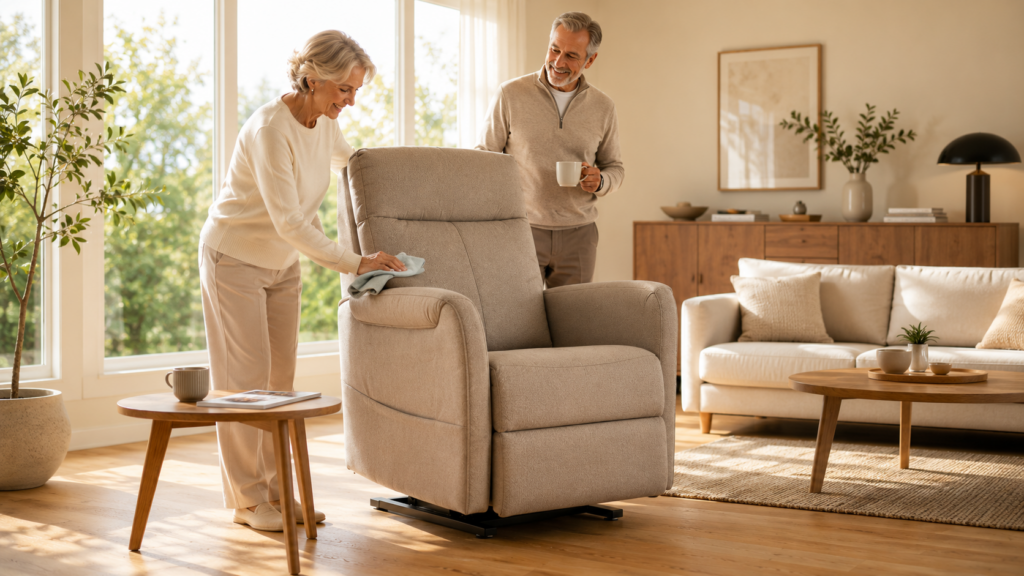
When you’re shopping for an electric lift chair, you probably think first about comfort.
How far does it recline?
Can it help with standing?
Does it offer Zero Gravity?
Can the backrest and footrest move independently?
But because a power lift chair plugs into the wall, there’s another practical question worth asking:
How much electricity does a lift chair use?
For most households, a lift chair is very different from an appliance that continuously consumes significant power. Its motors primarily operate when the chair is actually changing position.
However, exact electricity use varies by chair, motor system, power supply, frequency of adjustment, and standby design.
Understanding these factors can help you compare products more intelligently and plan your living room electrical setup properly.
Let’s break it down.
1. How Does an Electric Lift Chair Use Electricity?
A power lift chair contains electrically operated components that control its movement.
Depending on the model, powered functions may include:
- Raising the seat
- Lowering the seat
- Reclining the backrest
- Extending or retracting the footrest
- Adjusting seat tilt
- Changing seat height
- Moving into a Zero Gravity position
Electricity powers the actuators or motors responsible for these movements.
When you’re simply sitting in the chair without changing position, those motors aren’t continuously moving.
That’s an important distinction when thinking about energy consumption.
2. Does a Lift Chair Use Electricity All Day?
A lift chair can remain connected to electricity throughout the day, but that doesn’t mean its motors are running continuously.
Most of the noticeable power demand occurs when you press the controller and activate a powered movement.
For example:
You press the footrest button.
The actuator moves.
You release the button.
The movement stops.
Later, you activate the standing-assistance function.
The powered mechanism operates again.
So actual electricity consumption depends partly on how often the chair’s functions are used.
Some electrical components or power supplies may still draw a small amount of standby power while plugged in, depending on the chair’s design.
3. How Many Watts Does a Lift Chair Use?
There isn’t one universal wattage for all lift chairs.
Different products use different:
- Motors
- Actuators
- Transformers
- Control systems
- Numbers of powered functions
That’s why it’s better to check the specifications for the exact model rather than relying on a generic figure from another chair.
For example, the PHLEXI Chair 4A is specified with:
Power supply: AC 100–240 V, 50/60 Hz
Maximum power consumption: 73 W
This is a useful specification because it tells you the chair’s maximum rated power consumption—not that it continuously consumes 73 watts every hour of the day.
4. Maximum Power Consumption Is Not the Same as Daily Energy Use
This distinction is important.
Watts (W) describe power.
Kilowatt-hours (kWh) describe energy consumed over time.
If an electrical product rated at 73 W operated continuously at maximum power for one full hour, the theoretical energy use would be:
73 W ÷ 1,000 = 0.073 kWh
But a lift chair’s powered motors normally operate for short periods while changing position.
They don’t typically run at maximum power continuously for hours.
So you shouldn’t calculate lift-chair electricity costs by multiplying the maximum wattage by 24 hours a day.
That would significantly overstate motor-related energy consumption.
5. A Simple Example
Let’s imagine a theoretical chair that draws 73 W while its powered mechanism is operating.
Suppose all powered movements combined totaled 10 minutes per day at that power level.
Ten minutes is approximately 0.167 hours.
The theoretical motor energy would therefore be:
0.073 kW × 0.167 hours ≈ 0.012 kWh per day
Over 30 days:
≈ 0.36 kWh
This is only an illustrative calculation.
Actual consumption depends on the chair, operating load, movement, power supply, standby consumption, and how frequently the controls are used.
But the example demonstrates why looking only at maximum wattage can be misleading.
6. Does Zero Gravity Use More Electricity?
Moving into a Zero Gravity position requires powered adjustment on an electric chair.
So yes, electricity is used while the relevant components are moving.
However, once the chair reaches the selected position, the motors generally don’t need to continuously move just to maintain that position.
The same principle applies to other powered adjustments.
Electricity powers the movement.
That doesn’t mean the motor continuously runs simply because you’re sitting in a reclined position.
Always consult the specifications of the individual product for exact operating behavior.
7. Do More Motors Mean a Much Higher Electricity Bill?
Not necessarily.
A chair with multiple independently controlled functions may have more actuators than a simple single-motion recliner.
But electricity cost depends on how much energy those components actually consume and how long they operate.
Multiple motors can provide useful flexibility.
For example, the PHLEXI Chair – Yushan Award provides powered standing assistance alongside adjustable seat height, independent backrest and footrest positioning, and Zero Gravity functionality.
For someone using the chair throughout the day, the value of those adjustments may be more relevant than simply counting the number of motors.
8. What About Standby Electricity?
Some powered furniture may consume a small amount of electricity while plugged in even when the chair isn’t moving.
This is often called standby power.
The exact amount depends on the electrical system and power supply.
If energy consumption is an important purchasing factor for you, ask the manufacturer or supplier for information about both:
- Maximum operating power
- Standby consumption
This provides a more complete picture than wattage alone.
9. Should You Unplug a Lift Chair When You’re Not Using It?
Don’t automatically unplug powered furniture after every use unless the manufacturer recommends doing so.
For someone who depends on the lift function, repeatedly disconnecting the chair could mean powered assistance isn’t immediately available when needed.
Instead, follow the manufacturer’s operating and electrical instructions.
If the chair won’t be used for an extended period, check the manual for recommended storage or power-disconnection procedures.
10. Does a Lift Chair Need a Special Electrical Outlet?
Many residential lift chairs are designed to operate from standard household electrical supplies, but requirements vary by model and country.
The PHLEXI Chair 4A, for example, specifies an AC 100–240 V, 50/60 Hz power supply.
Before installation, check:
- Voltage requirements
- Power-supply specifications
- Plug type
- Outlet location
- Manufacturer instructions
Don’t assume that every chair has identical electrical requirements.
11. Be Careful With Extension Cords
Where you place the chair can affect its electrical setup.
A power cord stretched across the living room can become a trip hazard.
And an inappropriate extension cord or adapter may not meet the manufacturer’s requirements.
Whenever possible, plan the chair around convenient access to an appropriate electrical outlet.
Keep cables away from:
- Walking paths
- Footrest mechanisms
- Moving chair components
- Areas where the cord could be pinched
- Frequently moved furniture
Good cable management is both a design issue and a practical home-safety consideration.
For more ideas about planning an aging-in-place home, visit THE LIVE YOUNG’s Home Care Resource Center.
12. What Happens During a Power Outage?
Because lift chairs rely on electricity for powered movement, it’s important to understand what happens if household power is interrupted.
Backup systems vary by manufacturer and model.
Some chairs may have emergency backup functionality, while others may rely entirely on the main electrical supply.
This becomes particularly important when someone depends on powered standing assistance.
Before purchasing, ask:
- Does the chair have backup power?
- What does the backup system operate?
- How long is it intended to function?
- Does it require replaceable batteries?
- What should the user do during an outage?
Don’t wait until the electricity goes out to learn the answers.
13. How Can You Use a Lift Chair Efficiently?
You generally don’t need to change how you naturally use the chair simply to save electricity.
But a few sensible habits can help.
Avoid repeatedly moving the chair back and forth unnecessarily.
Stop at the position you actually want.
Keep the mechanism properly maintained according to manufacturer instructions.
Make sure nothing blocks the chair’s moving components.
And use the recommended electrical setup.
Efficiency isn’t only about energy.
It’s also about allowing the chair to operate smoothly and correctly.
How Much Does It Cost to Run a Lift Chair?
There is no universal answer because electricity prices vary by country, region, utility provider, and rate plan.
Actual consumption also varies between chair models and users.
A useful formula is:
Energy used (kWh) × local electricity rate = estimated electricity cost
For example, if a chair used 1 kWh over a given period and electricity cost $0.20 per kWh, the energy cost would be:
1 × $0.20 = $0.20
For a more accurate estimate, you would need actual energy consumption—including standby consumption—rather than relying solely on the chair’s maximum wattage.
Electricity Use Shouldn’t Be the Only Buying Factor
Energy efficiency is worth considering.
But don’t choose a chair based on wattage alone.
A lift chair also needs to fit:
The person.
The home.
The daily routine.
Consider:
- Seat height
- Seat width
- Seat depth
- Weight capacity
- Standing assistance
- Reclining range
- Independent adjustment
- Controller usability
- Upholstery
- Room dimensions
- Electrical setup
- Warranty
- Product support
A slightly different power specification may matter far less than whether the chair is comfortable and genuinely useful every day.
What About Passive Movement Recliners?
Powered seating can use electricity for functions beyond reclining and standing assistance.
The MOTiVO Passive Exercise Recliner incorporates passive movement technology into residential seating, with multiple speeds, positions, and programs.
Because different powered chairs perform different functions, energy specifications should always be evaluated for the individual product rather than assuming all electric recliners consume power in the same way.
Explore THE LIVE YOUNG Seating Solutions
PHLEXI Chair – Yushan Award
The PHLEXI Chair – Yushan Award combines powered standing assistance with adjustable seat height, independent backrest and footrest positioning, Zero Gravity functionality, and premium residential design.
It’s designed to provide advanced powered functionality while remaining a comfortable everyday chair for the home.
PHLEXI Chair 4A
The PHLEXI Chair 4A provides adjustable seat height from approximately 42–60 cm, backrest adjustment, footrest adjustment, seat tilt, Zero Gravity, and stand-up assistance.
Key electrical specifications include:
Power Supply: AC 100–240 V, 50/60 Hz
Maximum Power Consumption: 73 W
MOTiVO Passive Exercise Recliner
The MOTiVO Passive Exercise Recliner combines comfortable residential seating with passive movement technology, offering multiple speeds, positions, and programs.
More Home Care Resources
Explore THE LIVE YOUNG’s Home Care Resource Center for more information about lift chairs, powered seating, independent living, and creating a comfortable aging-in-place home.
Lift Chair Electricity Checklist
Before purchasing a powered chair, check:
- Power supply
- Voltage
- Frequency
- Maximum power consumption
- Standby consumption, if available
- Plug requirements
- Outlet location
- Cable routing
- Backup-power functionality
- Manufacturer recommendations
- Warranty coverage for electrical components
These details aren’t as exciting as Zero Gravity or premium upholstery.
But they’re part of choosing powered furniture intelligently.
Frequently Asked Questions
Do lift chairs use a lot of electricity?
Actual electricity consumption varies by model and usage. Lift-chair motors typically operate while the chair is changing position rather than continuously throughout the day.
How many watts does a power lift chair use?
There is no universal wattage. Check the specifications of the individual chair. The PHLEXI Chair 4A, for example, specifies maximum power consumption of 73 W.
Does a lift chair use electricity when you’re just sitting in it?
The movement motors aren’t continuously operating simply because someone is sitting in the chair. However, some powered furniture may have standby consumption while connected to electricity.
Does Zero Gravity use electricity?
On an electric chair, electricity is used while powered components move the chair into or out of the Zero Gravity position.
Can I leave my electric lift chair plugged in?
Follow the manufacturer’s instructions for the specific chair. If someone relies on powered standing assistance, keeping the chair available for normal operation may be important.
Will a lift chair significantly increase my electricity bill?
The impact depends on the chair’s actual consumption, frequency of operation, standby use, and local electricity rates. Maximum wattage alone shouldn’t be treated as continuous 24-hour energy consumption.
Final Thoughts: Power Consumption Is Only Part of the Picture
So, how much electricity does a lift chair use?
The answer depends on the chair and how it’s used.
A maximum wattage specification tells you how much power a product may draw under certain operating conditions.
It doesn’t mean the chair continuously consumes that amount all day.
For most buyers, the better approach is to consider electricity use alongside the bigger picture:
How often will the chair move?
Does it have the functions you actually need?
Does it fit the user?
Does it fit the room?
Is the electrical setup practical?
And will the chair continue to support comfortable independent living over time?
At THE LIVE YOUNG, we believe good powered furniture should combine thoughtful engineering with practical everyday living.
Because the best technology isn’t simply about using power.
It’s about using that power to make everyday life work better.
Internal Linking Suggestions
Use “aging-in-place home”, “home electrical planning”, or “home-care environment” to link to:
Use “premium powered lift chair”, “Zero Gravity positioning”, or “independent backrest and footrest adjustment” to link to:
Use “73 W maximum power consumption”, “AC 100–240 V”, or “adjustable seat height” to link to:
Use “passive movement technology” to link to:
MOTiVO Passive Exercise Recliner
Also internally connect this article to your existing posts about lift chair power outages, lift chair vs. regular recliner, lift chair placement, lift chairs for small spaces, how long lift chairs last, and lift chair maintenance.